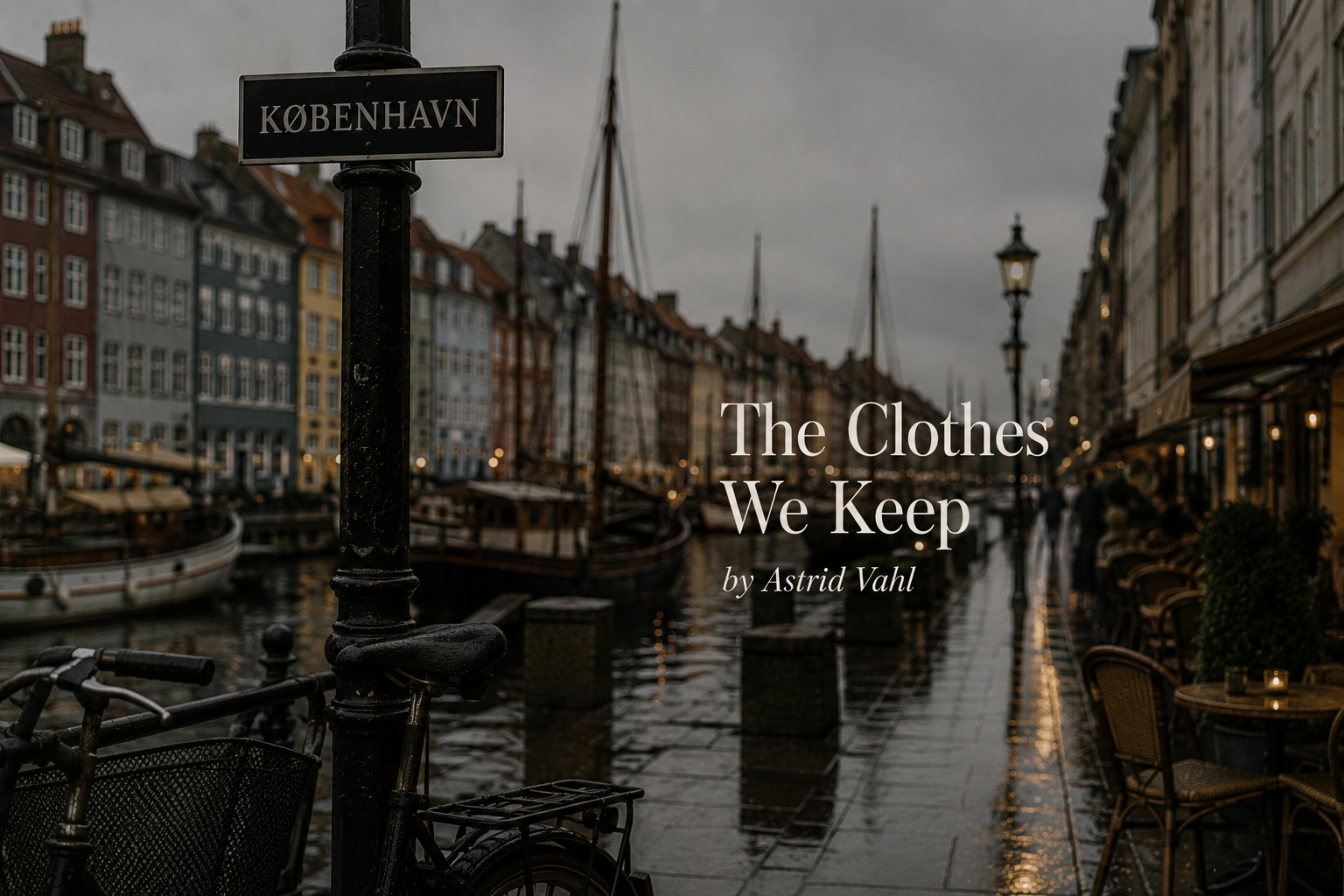
I love watching people in Copenhagen in the mornings. Especially when the air is a little cold.
People weaving between bicycles, coffees picked up in a hurry, scarves constantly being adjusted against the wind… At first glance, there is a strong sense of fashion in the city. But if you watch a little longer, you begin to notice something else: No one wants to look like they tried too hard.
Perhaps that is the most beautiful thing about Copenhagen style.
Dressing well here does not mean wearing more. Sometimes, a black coat worn for years, a well-cut pair of trousers, and leather shoes that have seen the rain countless times are enough.
Because in some cities, clothes are worn to be seen. In Copenhagen, they are often worn to be lived in.
And to me, that is where true luxury begins.
The fashion industry is constantly telling us about what is new.
New season.
New colour.
New silhouette.
New desire.
The moment we buy one piece, we are expected to turn our attention to the next.
And yet, almost none of the most valuable pieces in my wardrobe are new.
I have a dark coat that I have worn for eight years. Part of its lining was replaced a few years ago. There is a small worn spot along the edge of one pocket that probably no one notices but me.
If I saw it in a store today, would I buy it?
I don’t know.
But I would be sad if I lost it.
There is a great difference between the two.
Wanting something and becoming attached to it are not the same thing.
Perhaps this is one of the greatest problems with modern fashion: it has become extraordinarily good at creating desire, yet increasingly poor at creating objects we can form a relationship with.
One of the things I love about the streets of Copenhagen is that people’s clothes sometimes look genuinely worn.
The slight crease along the sleeve of a wool coat.
The leather of a bag softened by time.
A sweater that falls differently on the body after being worn again and again.
These are not imperfections.
They are traces left by time.
And a well-designed garment should be able to gain character with age rather than lose its value.
That is why, in recent years, I have started asking myself one very simple question before buying a piece of clothing:
Will I still want to wear this three years from now?
I don’t say five years.
Or ten.
Just three.
Because even three years is a remarkably long time at the speed of the fashion industry.
If the answer is yes, I touch the fabric. I look at the stitching. I try to understand whether its silhouette belongs only to today, or whether it will still feel relevant a few years from now.
Most of the time, I don’t buy it.
But when I do, I want it to remain part of my life.
Perhaps the luxury of the future will not be about owning more expensive things.
Perhaps it will be about owning fewer things and wanting them for longer.
I thought about this on a rainy afternoon in Copenhagen, while watching a woman unlock her bicycle in a coat she had clearly been wearing for years.
There was nothing new about what she was wearing.
But there was nothing that needed replacing either.
And I think that was the quietest definition of true luxury.
Fashion makes us desire what is new.
Style decides what stays.
Dagdroøm is where fashion and style come together in their cleanest form.